

In my previous article, we looked at how peer-reviewed papers linking COVID vaccines to cancer faced censorship through cyberattacks and smears.

Now, the opposite is happening. The review in Oncotarget, documenting over 300 peer-reviewed cases of new, recurring, or aggressive cancers tied to vaccination across 27 countries, has gone viral worldwide.
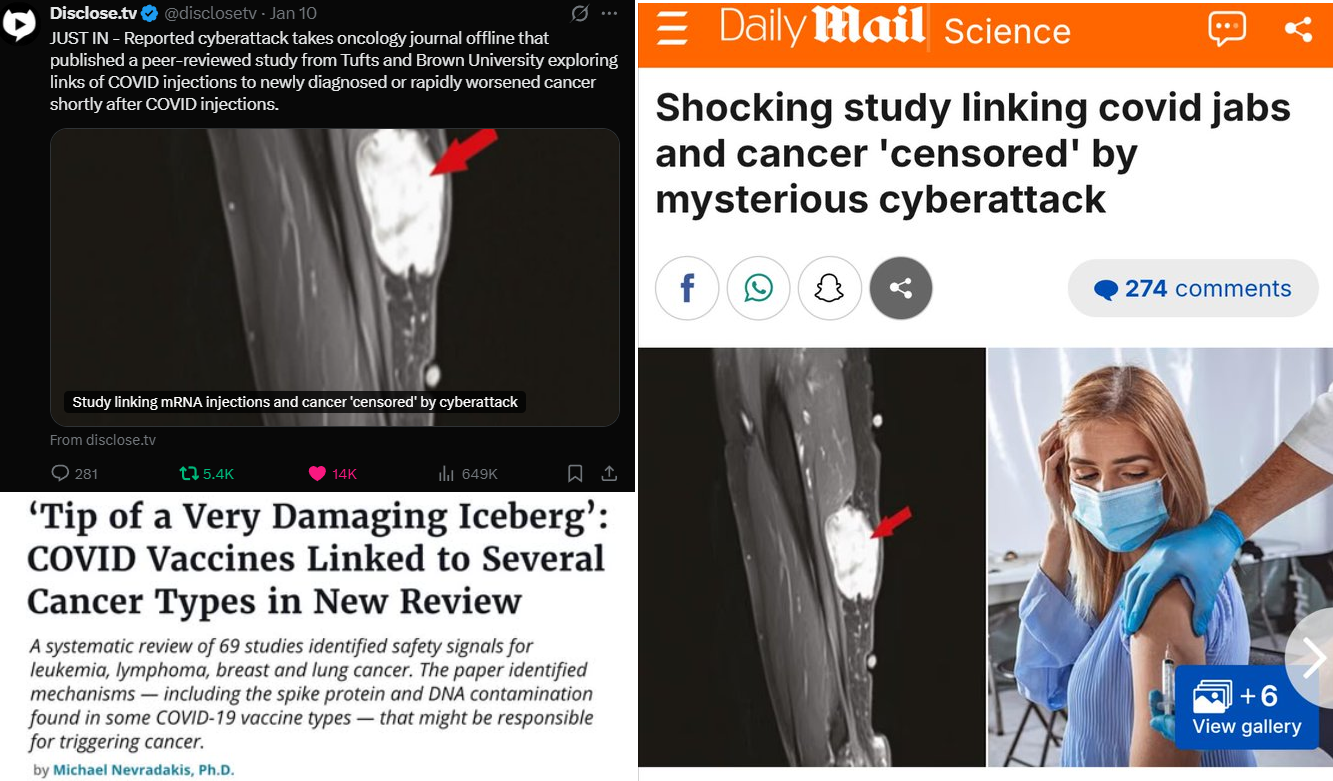
What started as a quiet January 3, 2026, publication exploded after the journal’s site was hit by a reported cyberattack, taking it offline. The attempted blackout backfired. Instead of burying the findings, the cyberattack turned them into a global news event.
People shared links, PDFs, and discussions everywhere. The more the journal struggled to stay online amid the cyberattack, the louder the story became. This must be causing real unease in Big Pharma and vaccine industry circles. Meanwhile, the smearing campaign against Dr. Wafik El-Deiry, one of the paper’s authors, continues unabated.
Dr. Wafik El-Deiry, addressed the backlash head-on. He described the personal attacks he faces for putting the work out there. “This is the type of ongoing public defamation I am being subjected to for pursuing scientific truth,” he wrote. He listed the slurs: “scientifically illiterate,” “pathetic whiny wuss,” even racial attacks and false fraud claims.
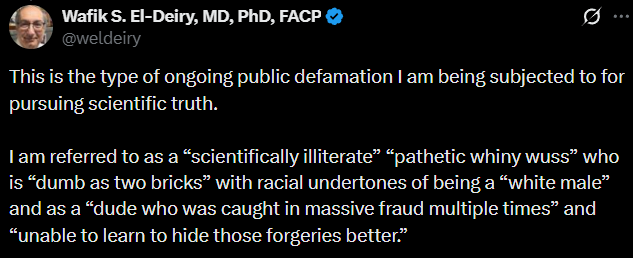
He added, “It should not be OK with anyone in a civilized society to falsely publicly and maliciously attack a physician and biomedical researcher who worked with a colleague to present the world’s published literature in a review on Covid infection, Covid vaccines, and cancer.”
Pfizer attempts to hire Dr Wafik El-Deiry
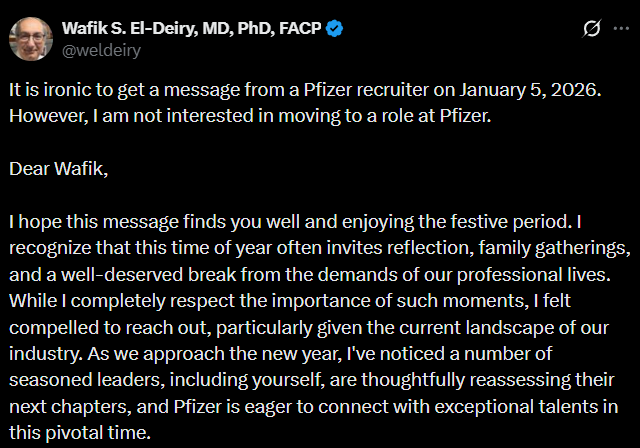
The situation grows stranger. Days after the paper was published, Pfizer reached out to recruit El-Deiry. A headhunter praised his expertise in oncologic sciences, highlighted his leadership roles, and floated senior positions at the company. El-Deiry shared the full message publicly and rejected it outright: “It is ironic to get a message from a Pfizer recruiter on January 5, 2026. However, I am not interested in moving to a role at Pfizer.”
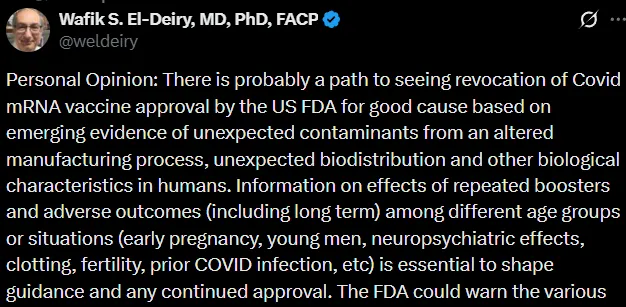
Meanwhile, he has been vocal about the need for thorough investigations into vaccine safety signals, issues like potential DNA integration, immune suppression, and cancer risks, that, if substantiated, could provide grounds to reconsider or even revoke emergency approvals.
Here is a company whose flagship product now faces these exact questions, quietly trying to bring one of its most prominent critic into its fold. One has to wonder: is this coincidence, or an attempt to neutralize scrutiny from the inside? The timing raises more questions than it answers.
As someone who worked in Big Pharma, I have no doubt that attempts like this involve heated discussions behind closed doors at the very highest levels. You don’t just reach out to hire a vocal critic of your company or its products without sign-off from top executives, board members, and even legal teams. It’s a massive risk that could backfire, reputational damage, bad press, or more skepticism about your vaccines. If the critic turns it down publicly, as El-Deiry did, it shines an even brighter spotlight on the issues, turning a quiet pitch into a PR nightmare. In my experience, these moves are calculated strategies to bring in or neutralize Key Opinion Leaders who sway medical opinions and prescribing habits.
What is a Key Opinion Leader?
For those new to the Pharma business, let me break it down simply. A Key Opinion Leader, or KOL, is a respected doctor, researcher, or expert whose views carry real weight in the medical community. They influence treatment guidelines, speak at conferences, publish papers, and guide other physicians on what drugs to use.
Pharma companies target KOLs because their endorsements can boost sales, shape regulations, and build trust in products. But it’s not just about hiring them outright, it’s about building relationships through consulting gigs, research funding, advisory boards, or even job offers to align their influence with the company’s goals.
To make this work, Pharma doesn’t leave anything to chance. Every doctor with the potential to prescribe medications, run trials, or bring in business is profiled in detail using advanced IT systems and databases. These aren’t basic Rolodexes; they’re sophisticated customer relationship management (CRM) tools that track everything about a physician’s professional and sometimes personal life. This includes hospital affiliations, specialty networks, speaking engagements, publication history, grant sources, and even social connections.
Take a look at the attached chart from one such Pharma IT application, it’s a real example of a “Sphere of Influence” map, the ones used in Veeva CRM (a leading tool for pharmaceutical sales and marketing teams).
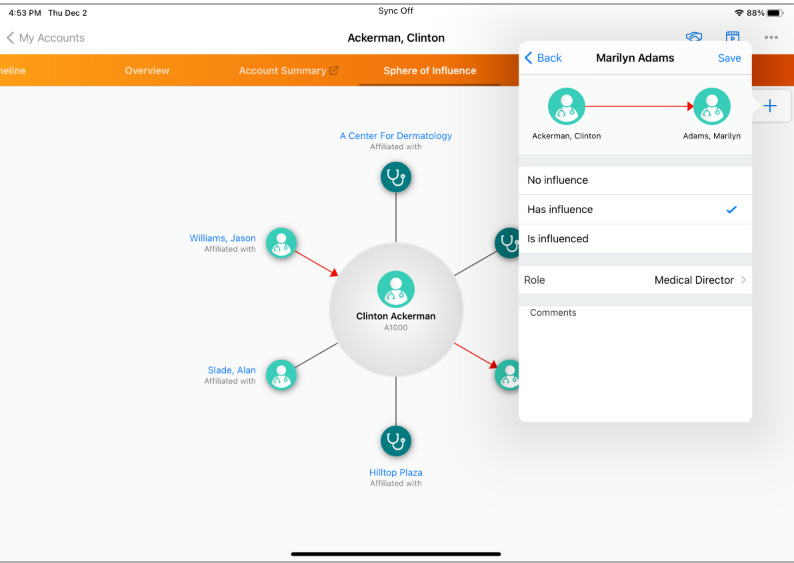
Here, the doctor named Clinton Ackerman is shown at the center (not a real doctor, just a sample name and profile used for illustration, but the app interface and features are genuine). The map visually lays out his professional network: red arrows indicate directional influence (like “Has influence” over others), while lines connect him to affiliated colleagues, clinics, and roles. For instance, it shows links to Marilyn Adams (marked as having influence over him, with her role as Medical Director at “A Center For Dermatology”), Jason Williams, Alan Slade, and places like Hilltop Plaza. The system tracks details such as roles, affiliations, and custom notes, all to help sales reps figure out who to approach first to sway prescribing decisions.
This kind of graphical tool is standard in Big Pharma CRM systems, pulling data from real doctor profiles to build influence networks. Why? To get a doctor to prescribe your drug, say, a new cancer treatment or vaccine, you need to understand how to sway them. Some are direct: offer data, samples, or education. Others resist, so you go indirect. if the map shows someone like Marilyn Adams influences Ackerman, you court her first, invite her to a dinner, fund her research, or get her on a speaker panel. She then nudges him toward your product.
In El-Deiry’s case, as a prominent oncologist questioning vaccine safety, recruiting him could flip his influence from critic to ally, quieting debates or redirecting focus. But as we’re seeing, when it goes public, it exposes the whole playbook.
So, what might El-Deiry be turning down by rejecting Pfizer’s overture?
As a former Big Pharma insider, I can make an educated guess based on how these recruitment plays unfold for high-profile experts like him, an accomplished oncologist with decades in research, leadership at Brown University, and a track record of challenging industry narratives. Pfizer isn’t just offering a job; it’s dangling a package designed to integrate him into their ecosystem, potentially silencing or redirecting his voice on sensitive topics like vaccine safety signals.
Given his expertise in cancer biology, translational research, and oncology risks tied to mRNA tech, this wouldn’t be mid-level. My bet is on a senior role in oncology, like Senior Vice President (SVP) of R&D Oncology (overseeing overall onco portfolio), or Vice President (VP) of Global Medical Affairs in Oncology (handling communications, KOL networks, post-market surveillance), or VP of Oncology Pipelines (advancing drugs from lab to clinic and shaping regulatory strategies). These align with Pfizer’s post-Seagen push into oncology.
Compensation is the big allure. Base salary for such an SVP or VP could run $500,000 to $800,000 annually (higher for a star recruit). Add bonuses (30-50% for hitting targets like trial milestones), and you’re at $650,000-$1.2 million. Equity (RSUs/options vesting over 3-4 years) often adds $1-2 million upfront, with more yearly, top R&D leaders have seen stock awards hit $4-5 million in strong years. Perks push the total to $1-2 million or more: relocation/housing allowances ($100,000+), executive transport (cars, chauffeurs, private jet access), top-tier health plans, and deferred compensation.
The catch is ironclad: an NDA locks down everything about Pfizer’s operations, data, and strategies, no more public critiques. Exits come with golden parachutes (1-2 years’ pay plus accelerated vesting, often millions), but non-compete/non-disparagement clauses could bar competing work or Pfizer-related comments for 5-7 years.
If more desperate, they might offer a Board role: less work (quarterly meetings, committees), pay around $335,000-$400,000 in cash/stock, plus visibility (TV interviews, op-eds for damage control, like Scott Gottlieb). It opens consulting gigs worth another $500,000+ yearly.
But the real scale difference is resources: he’d control a portion of Pfizer’s $10-11 billion annual R&D budget (based on 2026 guidance), with oncology a major focus, likely $2.5-3.5 billion or more annually post-Seagen, funding large-scale trials, AI tools, and global programs without constant grant-chasing. He could oversee hundreds to several thousand scientists/staff in oncology (part of Pfizer’s 12,000-15,000 total R&D headcount).
Compare that to his current academia role at Brown. Research budget, perhaps $5-10 million annually from competitive grants, leading 20-100 people (postdocs, students, techs), solid, but grant-dependent with ongoing fundraising pressure.
Academia gives independence to speak out and pursue truth without profit strings. Pharma offers massive firepower and financial security, but at the cost of aligning with the company’s agenda. Many academic doctors and scientists vocally support mRNA vaccines in order to catch the eye of Pfizer and other companies for potential recruitment into such lucrative industry roles. It’s like an American Idol audition where you hope one of the judges notices you. El-Deiry’s choice says a lot about prioritizing principles over the upgrade. In the end, his rejection keeps independence intact, but he’s walking away from a life-changing windfall and insider access. From Pharma’s view, it’s a missed chance to turn a thorn into an asset. For the rest of us, it’s a glimpse into how the system tries to absorb dissent.
Congratulations to Dr. Wafik El-Deiry for standing firm in the face of intense pressure, smears, and a lucrative offer that could have silenced him. In an era where integrity is rare and costly, his public rejection of the Pfizer outreach and continued defense of open scientific debate show true commitment to truth over convenience, exactly what medicine needs more of right now.
Signing off for now
A17
Thanks for the insider explanation on this Aussie17. It makes total sense. I am grateful for scientists like El-Deiry that still have their integrity intact. The future is going to be a scary place if there are not any more like him around. Censorship and shillmaking are their main moves against the tide.
Pfizer patented Endotoxin Lipid A as its preferred "adjuvant" obtained in uncontrolled quantities varying batch to batch, so Wafik is a natural choice.
In his 1997 paper Wafik El-Deiry demonstrated the dramatic effect of Endotoxin on cell proliferation using GMO p53 knockout mice.
He has numerous commercial interests related to p53.
https://geoffpain.substack.com/p/wafik-s-el-deiry-endotoxin-expert